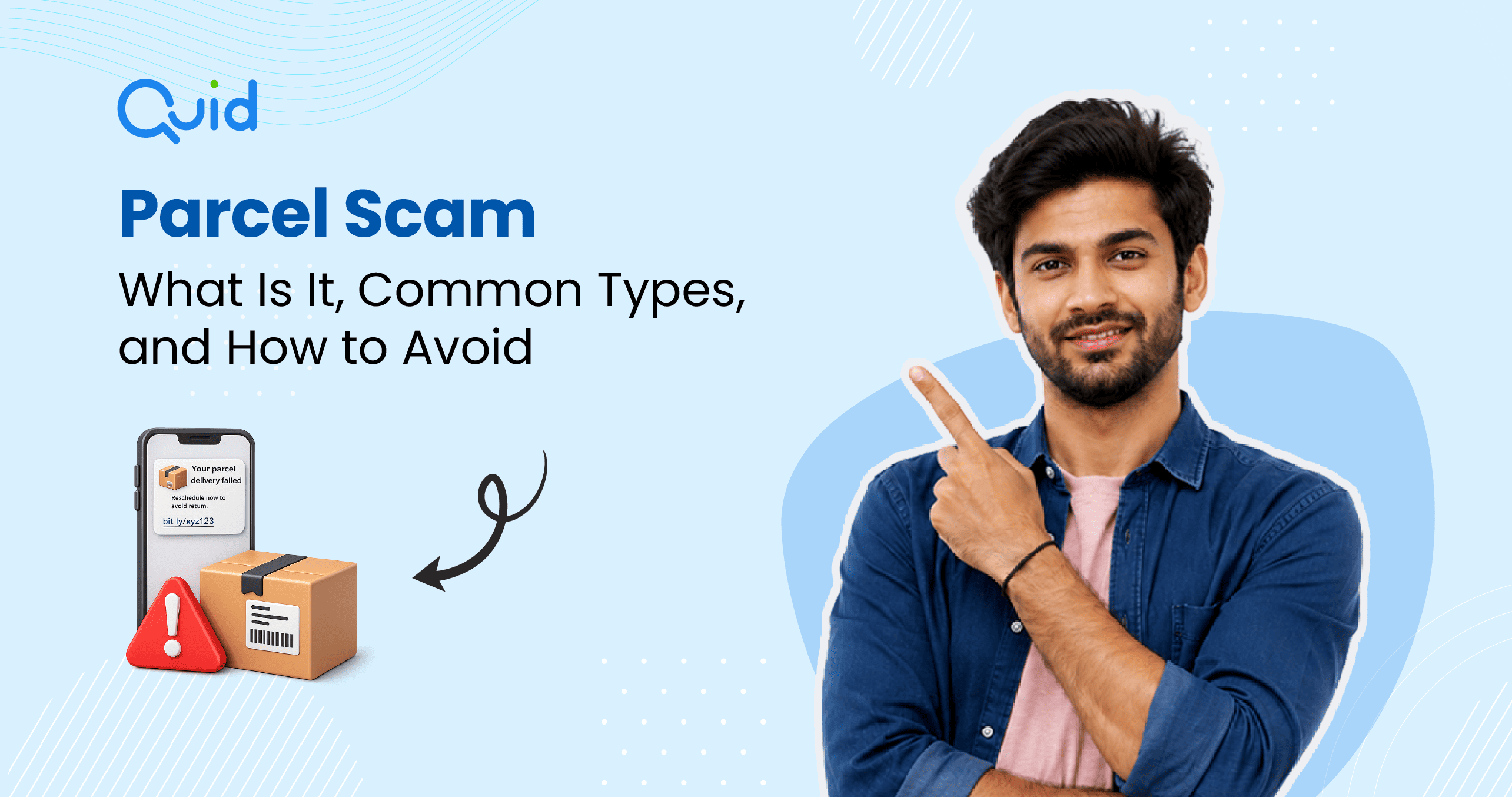
In today’s digital finance ecosystem, it is common to order a new credit or debit card, cheque book, or important banking document online and have it delivered to your doorstep. However, it has simultaneously created new opportunities for fraudsters to exploit the delivery system via deceptive parcel-related messages and fake courier alerts.
Scammers misuse the trust built around online financial deliveries. They disguise themselves as legitimate courier services or bank representatives and trick individuals into sharing sensitive information. Over here, awareness becomes the first line of defence. In this blog, we will explain what a parcel scam is, the common techniques used across India, and the practical steps to avoid becoming a victim.
A parcel scam is a fraudulent scheme in which scammers impersonate courier companies or bank agents to target individuals expecting financial products such as debit cards, credit cards, or cheque books. They send fake delivery notifications, often demanding payment for “customs,” “clearance,” or “re-dispatch” fees.
Their goal is to trick victims into sharing sensitive financial information, making payments for fake charges, or clicking malicious links that steal banking credentials or OTPs. These operations frequently use phishing websites or URLs that mimic official courier or bank domains, leading to immediate financial theft.
Read on: SIM Swap Fraud: How to Stay Protected
You receive a message that says “Your financial parcel is awaiting delivery” and urges you to click a link or make a quick payment. Scammers create malicious web domains that closely mimic major courier services.
These websites demand false delivery fees, create a false sense of urgency to make you act instantly, and capture your card details or login credentials, often succeeding before your real banking parcel even arrives.
A highly deceptive form of parcel fraud occurs when a scammer pretends to be a courier and shows up at your doorstep with a fake financial product. They try to steal your OTP or card details by claiming they need it to confirm the delivery.
Once they get your sensitive information, the scammer may give you an empty package or quickly disappear to complete the fraud. This trick takes advantage of your trust in delivery staff and bypasses security, often leading to immediate theft of your money or account details.
This scam works like OTP fraud, but instead asks for cash. You receive an unexpected parcel and are pressured to pay the delivery agent on the spot. Thinking you or a family member ordered something related to the bank, you end up paying the full amount.
In reality, you’re being charged a large sum for a package filled with worthless items, causing an immediate loss. In many cases, the scam is aimed directly at getting cash, tricking you into paying hundreds or even thousands for something you never ordered and that has no real value.
You may receive an SMS or email saying, "Update your address to receive your bank document parcel," supposedly from a delivery partner. During the call, the representative pressures you to click the link in the message and update your address immediately.
The link leads to a fake website designed to steal your banking information. It asks for card details, a payment, or an OTP, bypassing secure payment methods and putting your financial data at risk even before your real bank parcel arrives.
Scammers effectively exploit the principle of ‘Every coin has two sides.’ One offers the ease of online financial ordering built on years of ongoing trust development, and the other uses the fertile ground to its own advantage. They execute a fake parcel scam using tactics like bogus courier fraud messages, unexpected COD orders, and malicious phishing links. Being aware of how these scams work and recognising the red flags can empower you.
You must treat every unexpected parcel notification as a potential risk, verify details independently, refuse pressure-driven demands for payment or personal data, and share knowledge within the household about verifying deliveries and refusing requests for OTPs or card information. The right precautions prevent fraud and preserve the convenience of online delivery without compromise.







Get credit at first sight and be closer to your goals.
Download Now